
Supporting Customers Experiencing Financial Difficulty
View the Supporting Customers Experiencing Financial Difficulty PDF
Introduction
1.1 At AFIA, we work with our members to develop industry standards including Codes of Practice to improve industry practices, transparency, fairness, and customer confidence in finance. These objectives are aimed at strengthening trust in and the good standing of the finance industry in the community, especially where a Member's customer may be experiencing financial difficulty.
1.2 Given the vicissitudes of life, some customers may encounter unexpected and uncontrollable changes in their financial or personal circumstances that cause them to experience financial difficulty, such as:
- change in income or employment status, including loss of employment;
- reduction of work hours;
- downturn in business;
- breakdown of a relationship;
- serious illness or death of a partner or close family member; and
- illness or injury
- natural disasters.
1.3 Customers who are experiencing financial difficulty often require additional and more specialised support, including access to community and other support services, such as financial counselling. These customers might also be experiencing other personal circumstances that compound their financial difficulty, including mental health conditions, financial abuse, domestic violence, or addiction. For more information, see AFIA Guideline: Supporting Customers Experiencing Vulnerability.
1.4 This guideline is addressed to Members and is intended to complement the AFIA Finance Industry Code of Practice (the Code) to assist Members to understand and communicate with their customers who are experiencing financial difficulty. AFIA recommends that Members adopt bespoke policies that align their internal business operations with this Guideline and the Code, having regard to the types of products they offer and the types of customers they normally deal with
1.5 This Guideline may also be useful for customers as a reference tool when seeking assistance from Members.
About this Guideline
2.1 This Guideline has four purposes:
(a) To outline how Australian consumer protection laws [1] and the Code apply to Members’ financial difficulty programs.
(b) To provide practical guidance on what Members can do to meet these obligations when dealing with their customers who may be experiencing financial difficulties.
(c) To outline a framework for industry that balances the need for consistent, standardised access to financial difficulty assistance with the need for flexibility when responding to customers’ unique personal and financial circumstances.
(d) To promote best practice across the financial services profession.
2.2 AFIA encourages Members to use the principles in this Guideline to put in place internal processes, procedures, and policies to alert their customers to relevant and practical information about financial difficulty and strategies that can be undertaken to address these. A list of suggested information referrals is at Appendix 2.
What is financial difficulty?
3.1 ‘Financial difficulty’ arises when a customer is unable to repay what they owe and is experiencing difficulty meeting their repayment obligations. This can be because of an unexpected event or unforeseen changes outside of their control.
3.2 There are some common signs of financial distress that could alert a Member to ask a customer if they need support. These signs might include a customer:
- consistently making minimum or late payments on a credit card;
- being in arrears with a loan;
- not responding to repeated outbound calls, overdue notices or other lender communications;
- showing evidence of injury or illness;
- experiencing a change in employment circumstances;
- experiencing a change in personal circumstances (e.g. change in relationship status through separation, divorce or death);
- having unusual patterns of usage of credit card products and making requests for significant increases in credit card limits;
- carrying persistent balances or regularly exceeding credit limits;
- carrying balances on a credit card with a high interest rate; or
- making excessive use of other forms of short-term credit.
3.3 The Code encourages customers (and their guarantors or representatives, where appropriate) to contact their lender as soon as possible if they are experiencing financial difficulties so that their situation can be discussed and options can be considered, including a suitable repayment arrangement.
3.4 Members recognise that there are many different reasons for why and how their customers might experience financial difficulty. Members should have different options available to help their customers through a period of financial difficulty, having regard to the terms and conditions of the product. Guarantors may also be eligible for financial difficulty assistance.
3.5 The term “financial hardship” is used in this document when referring to the relevant provisions of the National Credit Code (NCC), a schedule to the National Consumer Credit Protection Act 2009 (Cth) (“the NCCP Act”), which requires lenders to meet certain minimum requirements in responding to a customer who notifies them of an inability to make repayments. Even if a customer is not eligible to change their credit contract under the NCC, a lender may still offer other forms of support and assistance.
3.6 AFIA encourages all Members to consider how they manage customers experiencing difficulties, noting that each customer is unique and may experience financial difficulties differently.
3.7 Financial difficulties can involve a consumer experiencing short-term difficulties or a temporary inability to meet their obligations on their credit contract, or financial hardship which may require a longer-term arrangement to help them. While small business customers do not have the same rights under law as consumers, a small business customer experiencing financial distress may also need temporary assistance with their repayment arrangements.
3.8 Members should encourage customers who are experiencing financial difficulty (or who think they are, or will be, unable to meet their existing financial obligations), to contact their lender as soon as possible. The sooner the lender is contacted, the sooner they can work with the customers to find a solution and try to prevent the situation from deteriorating further. [2]
3.9 Importantly, in working to find a sustainable solution to customers’ financial difficulties, any help that is available will depend on the customers’ specific circumstances and will be provided on a case-by-case basis. The Code describes the steps that Members may take depending on the specific circumstances of their customer’s financial difficulty.
3.10 Recognising the impact of financial difficulties on a customer (and what harm the customer may be exposed to) enables Members to understand how this might affect the customer’s experience. If Members do not understand the impact of financial difficulty and fail to respond to customer needs empathetically and fairly, the consequences for the welfare of the customer could be detrimental. There is also the potential risk of adverse regulatory or reputational issues arising from not taking a customer-centric approach.
3.11 Members should consider whether their policies and procedures set out circumstances when extra care should be offered, especially when vulnerability has been raised or identified. Examples of circumstances that indicate when a customer may be experiencing vulnerability include where a customer:
(a) is experiencing age-related impairment or cognitive impairment;
(b) is experiencing financial abuse, family or domestic violence, or age-related abuse;
(c) is seriously ill, or has a mental illness;
(d) is experiencing any other personal, or financial circumstances causing significant detriment (such as homelessness or drug addiction); or
(e) has language or literacy barriers.
3.12 This list is not intended to be exhaustive, and Members should consider each customer’s circumstances individually. [3]
Responding to customers experiencing financial difficulty
4.1 To communicate in a clear and timely manner to enable customers to make an informed decision about their options, Members should consider how they can:
(a) encourage customers experiencing financial difficulty to contact their lender early. Customers may not yet be in arrears when they contact their lender, and a temporary arrangement may help resolve the issue quickly;
(b) make information publicly available about their processes for working with customers in financial difficulty and ensure this information is accessible by customers (including older customers, people with disability, Indigenous Australians, rural and remote Australians, and people with limited English) in a reasonable way;
(c) employ a range of practices that can identify common indicators of financial difficulty. If the Member identifies that a customer may be experiencing difficulty paying what they owe under a loan (or is experiencing some other financial difficulty), then the Member may contact the customer to discuss the situation and the options available to that customer. This should be done on a case-by-case basis with sensitivity, respect, understanding and empathy;
(d) respond promptly (and within the timeframes set by the NCC if it applies), to any written or verbal communication or request from a customer or their representative to discuss financial difficulties (including if the customer is unable to meet their loan repayments or other obligations under their credit contract [4]), regardless of who the customer speaks to at the lender [5] – noting that customers can give both verbal and written hardship notices under the financial hardship provisions of the NCC;
(e) inform the customer whether it can provide assistance in relation to that customer’s financial difficulty and the reasons for the decision. In the case of financial hardship, specific NCC time periods and processes apply;
(f) (if the Member agrees to provide the customer with help in the form of changes to a loan agreement) inform the customer in writing about the details of the changes including:
(i) the repayments the customer needs to make under the proposed new arrangement;
(ii) what will happen at the end of the arrangement; and
(iii) whether, by accepting the proposed new arrangement, the customer will have any adverse consequences in relation to banking services or their credit history;
(g) comply with any additional NCC requirements, if applicable;
(h) make policies for financial difficulty or hardship matters involving joint account holders and co-borrowers clear;
(i) (if the customer asks), assist a joint account holder (or co-borrower) without involving the other joint account holder (or co-borrower) initially. Members should advise the customer when it will notify the other joint account holder (or co-borrower) that hardship assistance has been sought;
(j) have policies that take account of situations involving financial abuse, and family and domestic violence, to avoid making things worse for the customer as far as possible.
4.2 To work with a customer to agree on hardship arrangements that are sustainable, realistic and aimed at allowing the customer the opportunity to resolve their financial difficulty, Members should consider how they can (in agreeing to such an arrangement):
(a) take into account available information, including information the customer has given the lender about their financial situation;
(b) have regard to individual circumstances such as:
(i) the size of the household/number of dependents;
(ii) their level of indebtedness;
(iii) the amount of time the customer requires to sustainably repay the debt;
(c) make arrangements so that renegotiation can take place if the customer’s circumstances change;
(d) take an integrated approach to assessment of the customer’s circumstances by considering all credit facilities the customer has with their lender when assessing a request for hardship assistance;
(e) consider the appropriate length of the arrangement, taking account of the customer’s circumstances and financial position;
(f) where a customer’s circumstances indicate that a short-term solution will not help the customer overcome their financial difficulty, but the longer-term solution may be effective – give preference to the longer-term solution. If a Member determines it would not be appropriate to offer a contract variation under the NCC (because the customer’s financial situation is unlikely to recover) the customer will need to consider other options;
(g) help the customer understand whether accepting the proposed new arrangement will have any adverse consequences in relation to their credit history. This includes how their repayment history information will be affected while they are in a financial hardship arrangement and that repayment history information will return to reflecting arrears if they fail to comply with an arrangement and have not made a new arrangement with the Member when an arrangement ends;
(h) make the information to be collected from the customer as clear and simple as possible;
(i) encourage the customer to keep in contact with their lender, particularly if their personal circumstances or financial situation changes. Members may consider agreeing to a check-in date with the customer during the arrangement and/or contacting the customer when the arrangement is coming to an end.
4.3 In accordance with the Code, Members should not sell a debt (except as part of a funding arrangement or sale of business or business restructure) and should suspend collection or recovery action relating to an NCC-regulated loan while a customer’s request for assistance is being considered, or as required under the financial hardship variation provisions of the NCC, or while the customer is currently complying with a hardship arrangement.
4.4 Members should only use as agents and sell debts to debt collectors that comply with the ASIC and ACCC Debt Collection Guideline and the member’s own policies for supporting customers in hardship.
Informal Arrangements
4.5 There may be more minor or temporary individual instances of help that Members can provide to a customer informally without the need for a formal hardship arrangement, such as waiving a fee, refunding an interest charge, or providing a short payment grace period. However, where a hardship notice has been received by a Member and the NCC applies, the processes set out in the NCC will need to be implemented and followed by the Member. Members should take care that their staff are trained to recognise the giving of a hardship notice that triggers a more formal process.
Representatives
4.6 Where the customer has appointed a financial counsellor or other representative, the Member should accept the agreed industry standardised forms of appointment.
4.7 If a customer has appointed a representative and the lender:
(a) has made reasonable attempts to contact, or deal with, the representative and has been unsuccessful; or
(b) reasonably believes that the representative is not acting in the customer’s best interest, or it is otherwise reasonable to do so in the circumstances
the Member may communicate directly with the customer. This will ensure that the customer is getting the right information from the Member at the right time. Members may choose to communicate directly with the customer if they consider that the customer’s appointed representative is a debt management firm without an appropriate credit licence. [6]
4.7 Members may also consider whether they should, where appropriate, advise customers of free alternatives to using a debt management firm (for example the member’s internal dispute resolution schemes, the National Debt Helpline [7] or Way Forward Debt Solutions [8] or another service).
Making information available
4.8 Members should consider whether information about financial difficulty assistance is prominently presented and readily accessible through multiple channels (including digital platforms and mobile banking applications) to assist customer/staff awareness and guidance. Member websites should include the promotion of financial difficulty assistance programs on their homepage. The financial assistance page should include links to information including:
(a) how to contact the Member about financial difficulty assistance;
(b) details for financial counselling services and the National Debt Helpline; and
(c) where relevant, emergency support packages and contact numbers following natural disaster events.
Complaints
4.9 Members should make information available on their website about how a customer can make a complaint and how those disputes are managed, app or other platforms, including information about the applicable timeframes for considering, and responding to, customer complaints.
Appendix 1: Further support and advice
Organisations and Regulators
AFIA
afia.asn.au
Australian Financial Complaints Authority (AFCA)
www.afca.org.au
AFCA is a free, independent dispute resolution scheme to deal with complaints from customers and small businesses about financial services products.
Australian Securities and Investments Commission (ASIC)
asic.gov.au
ASIC is Australia's integrated corporate, markets and financial services and consumer credit regulator.
Money Smart
moneysmart.gov.au
Money smart is the Australian Securities and Investments Commission's (ASIC) website for consumes and investors.
Australian Financial Security Authority (AFSA)
www.afsa.gov.au
The AFSA is an executive agency responsible for Australia's personal insolvency system. They work to support this system to help protect customers.
Australian Human Rights Commission – Aboriginal and Torres Strait Islander social Justice
humanrights.gov.au
Australia’s National Human Rights Institution.
Finance, Debt, and Legal issues
National Debt helpline
ndh.org.au
Tel: 1800 007 007
This provides free and independent financial counsellors around Australia.
Small Business Debt Helpline
sbdh.org.au
A free, independent and confidential service that provides help for small business owners and sole traders in financial difficulty.
Victims Support ACT
Tel: 1800 822 272
Provides information support and referrals for victims of crime who may be eligible for financial support.
Child support
Tel: 131 272
Provides information about, and applications for, child support.
Centrelink Social worker
Tel: 132 850
Help with applying for a crisis payment and other benefits, as well as short-term counselling and referrals.
Legal Aid
Find a legal aid commission at www.nationallegalaid.org
Community Legal Centres (CLC)
Find a local CLC at www.naclc.org.au
Financial Counselling
www.financialcounsellingaustralia.org.au
There are a variety of financial counselling organisations throughout Australia. Please find a non-exhaustive list below:
Australian Capital Territory – www.carefcs.org
Rural Financial Counselling Service (RFCS)
New South Wales – www.fcan.org.au
Queensland – www.fcaq.org.au
South Australian and North Territory – www.safca.org.au
Tasmania – www.fcat.org.au
Victoria – www.fcvic.org.au
Western Australia – www.financialcounsellors.org
Rural & Small Business Financial Counselling Service – Southern Queensland – www.rfcssq.org.au
Good Shepherd
goodshep.org.au
Way Forward
wayforward.org.au
Financial Rights Legal Centre
financialrights.org.au/factsheets/financial-hardship
Advice and Support
1800 ELDERHelp
Tel: 1800 353 374
A national free call phone number that automatically redirects callers seeking information and advice on elder abuse with local phone line services.
Elder Abuse Action Australia (EAAA) knowledge hub Compass
www.compass.info
Information and resources available for older Australians and the broader community.
The National Legal Aid Family Violence Law Help website
www.familyviolencelaw.gov.au
Provides advice on domestic and family violence and the law in Australia.
Dementia Australia
www.dementia.org.au
Provides information to support people with concerns about memory and thinking to understand dementia.
National Dementia Helpline
Tel: 1800 100 500
Learn about support services and education programs.
Appendix 2: Further reading
AFIA — AFIA Codes of Practice
Money Smart — Financial abuse guidelines
Australian Institute of Health and Welfare — Insights into vulnerabilities of Aboriginal and Torres Strait Islander people aged 50 and over
Australian Financial Complaints Authority (AFCA) — AFCA Approach to joint facilities and family violence; The AFCA Approach to financial elder abuse
Australian Securities and Investments Commission (ASIC) — RG 274 Product design and distribution obligations; ASIC (2019), Corporate Plan 2019-2023
The Australian Transaction Reports and Analysis Centre (AUSTRAC) — Assisting customers who don’t have standard forms of identification
Australian Banking Association (ABA) — Financial Abuse Industry Guideline
Supporting Women’s Financial Safety — Supporting Women’s Financial Safety: A Guide to Prevention and Action on Financial Abuse within the Financial Service Sector
The Australian Financial and Security Authority (AFSA) — Vulnerability Framework 2022-25; Council of Financial Regulators, New Zealand, Customer Vulnerability Framework
Australian Institute of Health and Welfare — Insights into vulnerabilities of Aboriginal and Torres Strait Islander people aged 50 and over
The World Health Organisation (WHO) — Abuse of older people
The Australian Transaction Reports and Analysis Centre (AUSTRAC) — Assisting customers who don’t have standard forms of identification
Centre for Women's Economic Safety (CWES) — Designed to disrupt: Reimagining banking products to improve financial safety
Gendered Violence Research Network — Understanding Economic and Financial Abuse in First Nations Communities (March 2021)
UK Financial Conduct Authority (FCA) — FG21/1: Guidance for firms on the fair treatment of vulnerable customers
Thriving Communities Partnership — Fostering Financial Stability for people in Prison - Phase 2 (Research Report November 2022)
Appendix 3: Financial Counselling Agency Authorisation Form
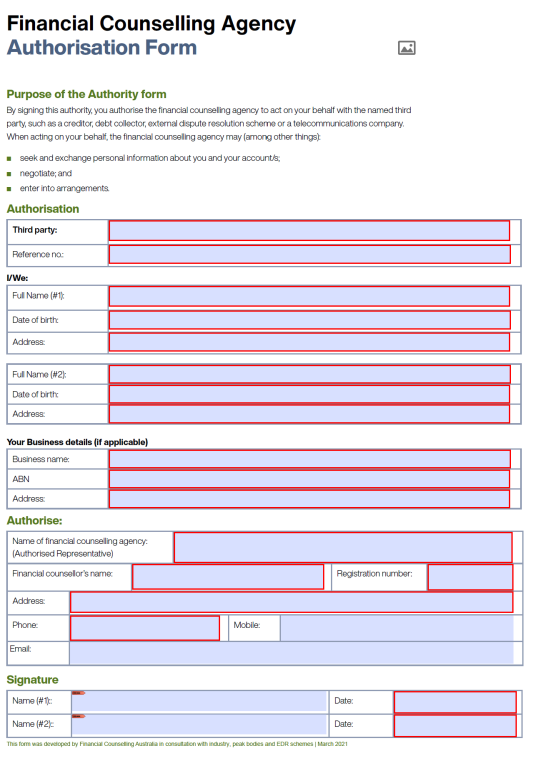
Purpose of the Authority form
By signing this authority, you authorise the financial counselling agency to act on your behalf with the named third party, such as a creditor, debt collector, external dispute resolution scheme or a telecommunications company. When acting on your behalf, the financial counselling agency may (among other things):
- seek and exchange personal information about you and your account/s;
- negotiate; and
- enter into arrangements.
Guide – Financial Counselling Agency Authorisation
Purpose of the authority
The purpose of this form is to have an agreed acceptable authority a financial counsellor can send to a third party. A third party could be a creditor, debt collector, external dispute resolution scheme or a telecommunications company. The authority covers all accounts that a person has with that third party.
It is important that your client is aware of how the authority will work.
The ACCC/ASIC Debt Collection Guideline at Section 9 provides information regarding the expectation of creditors and debt collectors that they will accept this authority.
Using the authority
A client may give a financial counselling agency the authority to act on their behalf with a third party. This means that the third party will deal with the agency.
The financial counselling agency and its representatives must do the following:
1. Include the financial counsellor's national registration number on all correspondence with the third party including the authorisation form (this enables the third party to verify your identity);
2. Notify the third party in writing if the financial counselling agency stops assisting the client (notification is not necessary if the matter has settled); and
3. Notify the third party if the financial counsellor acting on behalf of the client changes.
Separate authorities
A separate authority is required for each third party. You only need one authority for each entity (for example, if a bank has divisions the authority covers the bank and those divisions). A separate form is also required to make a complaint to an external dispute resolution scheme. This is to ensure that:
- Each third party gets a clearly addressed authority; and
- There is no confusion about how many third parties there may be; and
- To avoid explaining the possible privacy implications of sharing this information.
Explaining the authority
You must explain to your client why they are signing the authority form. This information will cover the following:
- The authority is required to access the personal information of the client that is held by the third party. The Privacy Act requires that the third party has the client's consent to access any of the client's personal information.
- The authority also means you can act on behalf of the client to deal with the third party. This means that the third party will deal with the financial counsellor as if it were dealing with the client.
- That you have professional and ethical obligations as a financial counsellor and these include that you will at all times keep the client informed of developments.
- That you will seek instructions from the client when major decisions are required. By then acting on those instructions you are then able to make arrangements or settlements with the third party that are binding (on behalf of your client).
- Explaining that it is important that the information provided to the third party must be true and correct.
- Explain that the third party may still send routine correspondence to the client or correspondence as required by law (for example, account statements). Correspondence relating to the dispute or inquiry must be sent to the financial counselling agency.
- The client can revoke the authority at any time and you will inform the third party accordingly.
- When you close the client's case, you will also revoke the authority with the third party.
Account numbers
Providing at least one account number or a reference number on the form will assist the third party in identifying the client's accounts. If an account number is not available leave this section blank but explain why in any cover letter or email.
Additionally, the account number, product type and account holders should be included in any cover letter or email.
Client details
You should provide as much information as you can to help the third party identify your client. This information may include your client's full name, date of birth and address, plus the address where the service was provided where relevant.
There may be circumstances where a client cannot provide their address. This could be because, for example, the client is homeless or is escaping family violence. If this situation applies then you should leave this section blank and explain why or provide further information in the cover letter that the third party can use to identify the client.
Revoking the authority
An authority can be revoked at any time and for any reason. Common situations when an authority is revoked are:
- The financial counselling agency ceases to act on behalf of the client,
- The client has not responded within a reasonable period of time, or
- The client puts in place another authority.
You need to revoke the authority in writing when you cease to act for the client. If the matter is settled then there is no need to revoke the authority if it is clear between the parties that the matter has concluded.
Can the third party creditor contact your client directly?
A third party can contact your client directly if:
- Your client requests that the third party contact them;
- You do not respond to communications from the third party within a reasonable time (7 days) and the third party has warned you that they will contact your client if you do not respond in a reasonable time (7 days); and
- The third party asked for written authority and you do not provide that written authority in a reasonable time.
Note: If the third party contacts the client directly it does not revoke this authority.
Disclaimer: The Australian Finance Industry Association gives no representation, makes no warranty, nor takes any responsibility as to the accuracy or completeness of any information contained herein and will not be liable in contract, tort, for negligence or for any loss or damage arising from reliance on any such information.
Footnotes
1. The National Consumer Credit Protection Act 2009 (Cth) is the law governing consumer credit in Australia and is designed to protect consumers’ interests. The NCCP Act includes the National Credit Code as a schedule to that Act.
2. Members should note that where they are contacted by an individual customer (i.e. not a small business) they should be careful to consider whether obligations under the hardship provisions of the NCC apply.
3. Some AFIA members might follow a similar approach when assessing a request for assistance from a small business; however, the information needed will be different and may be more extensive. AFIA members may also have additional options available to assist a small business - for example a small business customer may be able to access a temporary increase in an overdraft facility limit, a deferment of scheduled repayments consolidation or restructure of facilities.
4. NCC, s 72.
5. Neither the Code nor the NCC limit who the customer can speak to when they contact the Member and as such, Members should ensure that all their staff have had sufficient training to be able to recognise signs of financial difficulty or hardship.
6. Refer to the National Consumer Credit Protection Regulations 2010 – Regulation 4B.
7. The National Debt Helpline offers a free, independent and confidential service for those experiencing financial troubles. Call 1800 007 007 or visit ndh.org.au.
8. Way Forward is a not-for-profit organisation established to help people manage and repay their debt. Way Forward negotiate arrangements with multiple creditors on behalf of their clients. Their services are funded by voluntary donations and provided at no cost to their clients: wayforward.org.au.