
Supporting Customers Experiencing Vulnerability
View the Supporting Customers Experiencing Vulnerability PDF
Introduction
1.1 At AFIA we work with our members to develop industry standards including Codes of Practice to improve industry practices, transparency, fairness, and customer confidence in finance. These objectives are aimed at strengthening trust in and the good standing of the finance industry in the community, especially where a customer may be experiencing vulnerability.
1.2 Customers may encounter changes in their financial or personal circumstances that cause them to experience vulnerability. Characteristics of vulnerability may include, but are not limited to:
- age-related impairment;
- cognitive impairment;
- family or domestic violence;
- financial abuse;
- mental health issues;
- addiction issues;
- serious illness or injury;
- insecure housing or homelessness;
- language or literacy barriers;
- issues related to cultural norms or expectations; or
- other personal or financial circumstances or events that cause significant hardship.
1.3 Vulnerability may be temporary in some cases and can happen to anyone. Customers experiencing vulnerability may require specialised support, including access to community and other support services. They will likely not only be experiencing financial difficulties but also experiencing other factors or personal circumstances (such as those listed above) which may be associated with their financial hardship.
1.4 This Guideline is intended to help to raise awareness of the factors or conditions that may cause or lead to customer vulnerability, promote consistent approaches to support for customers experiencing vulnerability, and assist Code members to consider and develop processes and procedures that are appropriate to their business and the circumstances of their customer in each case.
How a customer can experience vulnerability
2.1 Any customer could find themselves experiencing temporary, sporadic, or permanent vulnerability. Vulnerability can manifest itself in different ways and is a personal experience. Vulnerability is situational and customers can experience vulnerability in one situation and not others. A customer’s vulnerability can be impacted by a variety of factors, such as:
- demographic factors;
- lower financial and/or business literacy;
- an insecure personal situation;
- domestic or family violence;
- language barriers;
- access to technology;
- personality or social characteristics;
- limited support networks;
- a criminal or custodial history;
- adverse health (including mental health);
- current life events;
- external circumstances (such as theft, misappropriation of funds, reduced economic conditions, or natural disasters).
2.2 Customers can experience multiple vulnerabilities at the same time and one vulnerability can increase the risk of secondary or additional vulnerabilities. Although some customers might display some vulnerability factors or drivers, they may not suffer harm as a result. Their experience of the particular vulnerability depends on the circumstances.
2.3 The below table sets out some examples of drivers (events or circumstances) that have the potential to contribute to vulnerability:
| Health | Life events | Resilience | Capability |
|---|---|---|---|
| Physical disability | Bereavement or an ending relationship | Low savings or nil security buffer | Limited knowledge or confidence in managing personal finances |
| Deteriorating mental health condition | Domestic or family violence | Over indebtedness | Low literacy and/or numeracy skills |
| Addiction | Caring responsibilities | Inadequate, insecure or erratic income | Low or limited digital skills, or digital exclusion |
| Limited mental capacity or cognitive disability/impairment | Income shock from workplace injury or serious accident | Emotional vulnerability/fragility | Learning difficulties |
| Chronic or severe illness | Recently migrated | Time poor | Limited or nil community support networks |
| Being convicted for a criminal offence or being incarcerated | Language barriers and isolation | ||
| Enduring a natural disaster | Lack of knowledge of consumer rights |
How to recognise when a customer may be experiencing vulnerability
3.1 Members can encourage their customers to tell them about vulnerabilities that they may be experiencing so that they can work with those customers to assist with appropriate support. Otherwise, Members may remain unaware of the customer’s vulnerability and be unable to offer that customer available support.
3.2 Recognising and understanding the impact of vulnerability on the specific needs of customers (as well as the potential harm they might be vulnerable to) enables Members to appropriately recognise how this might affect the customer experience.
3.3 Health (including mental health or cognitive conditions, disabilities, and addictions)
- Health conditions or illnesses can affect the ability of individuals to carry out day-to-day tasks, thereby increasing their vulnerability. Customers may be reluctant to bring problems to the attention of their financial services organisations out of fear that they will be misunderstood.
- For example, customers with dementia and/or Alzheimers disease can experience memory loss, difficulty with speech or writing or decreased/poor judgment. Sometimes these impacts can be episodic and at other times more acute.
- Mental health conditions or addictions (such as drugs, alcohol and gambling) can also be linked to over-indebtedness and contribute to temporary and permanent loss of income. Gambling, for example, can cause individuals to experience multiple forms of debt. Substance abuse, for example, can impede the ability of individuals to responsibly manage their money and finances.
3.4 Older Australians
- Decline in health and functioning mean some older Australians might have diminished capacity for self-care or self-protection, leaving them vulnerable to abuse or mistreatment.
- The abuse of an older person can be a single act, or a series of acts (as well as non-action or inappropriate action), occurring within any relationship where there is an expectation of trust, and which causes harm or distress to the older person. This type of violence constitutes a violation of human rights and includes physical, sexual, psychological and emotional abuse, financial and material abuse, abandonment, neglect and serious loss of dignity and respect. Older people can experience one specific type of abuse, but they may also experience multiple forms of abuse concurrently.
3.5 Diverse cultural backgrounds, including First Nations peoples [1]
- Cultural norms and expectations around wealth, resources, the management of household finances, and culturally influenced care-giving roles may also increase risks of vulnerability. This could also create barriers to accessing traditional financial services and products available to other Australians.
- Customers who live in rural or remote communities may experience difficulties accessing financial products, social services and basic technologies.
- These difficulties surrounding access to technologies and remoteness can especially increase the risk of vulnerability to First Nations peoples (for example, by being exposed to financial fraud, predatory sales tactics or abuse). Please see further information below on financial abuse.
3.6 Domestic or family abuse/violence
- Domestic or family violence is a driver of vulnerability and includes behaviour that coerces, controls or causes a person to be afraid for their safety and personal security.
- This form of abuse manifests in different ways and at different times. Individuals do not need to be physically hurt to experience domestic or family violence. The abuse can be in the form of a pattern of behaviour that causes the individual to fear for their own safety, or a dependent and/or their property. This includes emotional and psychological abuse, physical, sexual, verbal, social and financial abuse.
- Coercive control is when someone uses repeated patterns of abusive behaviour against another person to, over time, instil fear and to take away the person’s freedom and independence. This dynamic underpins domestic and family violence.
- Individuals suffering domestic and family abuse can be at risk of identity theft and fraud, where a partner (or ex-partner) may use their personal information to apply for credit products in their name.
- An example in a family business context includes a family member being coerced into agreeing to directorships or loans. Further information on financial abuse and its impact on customers is provided below.
- Excessive evidentiary requirements for individuals experiencing domestic and/or family violence can risk re-trauma. Individuals may also find it difficult to provide certain evidence to providers if they are subject to coercive or controlling behaviour by their partner or family member.
3.7 Financial and business literacy
- Some customers might have low knowledge of financial matters and/or low confidence in managing money. Some may also be less likely to understand how to manage their product, service or technology or be unaware of their legal and consumer rights.
- Some businesses can be at risk of being significantly impacted by the personal circumstances and vulnerabilities of individuals behind them, such as their business literacy. This can include, for example, understanding business and personal debts, personal guarantees, and their implications.
- If English is their second language, this may further impact a customer’s financial and business literacy capabilities.
3.8 Digital Restrictions and Exclusion
- Some customers using non-digital-based products may find it difficult to use particular types of communication channels or face challenges accessing digital communications, leading them to be disengaged or excluded.
- For example, a disability might prevent a customer from attending meetings in person or a customer may have limited digital capacity which will prevent them from accessing services online.
- People living in regional, rural and remote areas in Australia may also experience practical difficulties in accessing services due to telecommunications coverage issues.
- People inside the prison and corrections system face financial challenges that prevent control of their finances and access to financial management support. They may have accrued debts before entering the corrections system or be unable to manage existing payment plans. They can be vulnerable to financial abuse and require equal opportunity and support like other customers and clients. Issues with identification are a common barrier in prison, causing delays in support.
3.9 Natural disasters
- In Australia, natural disasters are increasing in frequency and intensity. Individuals can be significantly impacted by disasters such as bushfires, cyclones, storms, floods or other severe weather. These events can disrupt normal life and create challenges for people managing their finances.
- Individuals may experience include loss of income, property damage and loss, increased expenses, disruption of banking services, insurance issues and long-term financial repercussions such as decreased property values and ongoing expenses.
3.10 Financial abuse
- Financial abuse occurs when someone takes away another person’s access to money, manipulates another person’s financial decisions, or uses another person’s money without their consent.
- Financial abuse can manifest itself within relationships, including by partners, family members, friends, carers, or guardians. The increasing use of digital products can place people experiencing vulnerabilities at risk of harm from financial abuse.
- Nearly 1 in 30 women and 1 in 50 men are subjected to financial abuse in any given year in Australia. Over 623,100 women and men were subjected to financial abuse by a current or former partner in Australia in 2020 alone, with costs of $5.7 billion to the victim and $5.2 billion to the economy.
- While financial abuse can happen to anyone, vulnerable people, such as older Australians or those with a disability or cognitive impairment, are at greater risk of being subjected to it, as they are more likely to depend on others for help with their financial tasks and decisions.
- A person can be financially abusive in a variety of ways. Some signs can include:
- controlling another person’s access to money: such as restricting access to bank accounts, credit cards or cash, making another person ask permission to spend their own money, denying someone access to the internet, phone, or transport to prevent them from working or studying, refusing to contribute to shared costs of child support or refusing to provide enough money for living expenses or for costs related to raising children.
- using another person’s money without their knowledge or consent: such as forging another person’s signature, withdrawing, or transferring large amounts of money from their bank account, using their credit card, cancelling, or hiding bank/credit card statements, using bills, rent or mortgage money for someone else, or selling their property.
- signing legal documents: including forging signatures, forcing another person to sign documents that they don’t understand, taking out loans, credit cards or debts in another person’s name without their permission.
- threatening or punishing someone: including making another person feel guilty if they don’t give you money, isolating or threatening someone from their family or friends if they don’t give them money.
- The potential warning signs of financial abuse to be aware of include:
- a customer expressing concerns about missing funds, or personal or financial documents
- unusual requests such as adding an additional party as a signing authority
- unusual or uncharacteristic transactions, such as large increases in withdrawals or unusual purchases or third-party transfers, for example an overseas holiday or a new car
- transactions are made from a location where the customer is unlikely to be located
- changes are made to an address on an account by an authorised third party, or requests are made by the authorised third party to send correspondence to them
- changes in the operation of an account or unusual activity following the appointment of an enduring power of attorney
- There is also an increased risk of financial abuse during major crises that result in economic pressure on customers, such as natural disasters, financial or economic crises and pandemics.
- Financial abuse can happen in sensitive and complex circumstances. In some cases, customers will find it difficult to seek help, report abuse or tell financial providers that they are vulnerable. Some customers may not be aware that they are being subjected to financial abuse, particularly where information is being withheld from them or where they have limited financial literacy capabilities.
- If financial abuse occurs in a relationship where the customer trusts or depends on the abuser, the customer may fear reporting the abuse for a range of reasons including:
- fear of losing the relationship, possible retaliation from their abuser or risk of being isolated from their family
- being dependent on the abuser for their care and/or the care of children and worrying about how they will manage without this support
- they may be reluctant to believe that someone they trust is exploiting them
- they may want to shield their abuser from legal repercussions, despite wanting to stop the abuse
- they may believe it is their fault or feel ashamed that their child or family member is harming them
- they may fear that no-one will believe them or a view that reporting the abuse will be pointless
- A customer may find it difficult to report financial abuse if they are isolated, have limited mobility, have cognitive impairment, speak limited English, or are dependent on family members or others for support and access to services. Cultural factors may also influence perceptions of financial abuse as well as approaches to problem-solving among people from culturally and linguistically diverse communities.
- Individuals who have experienced financial abuse may face challenges in being inappropriately excluded from accessing financial services.
Considerations for AFIA Members
4.1. AFIA Members have committed under the Code to treat customers who experiencing vulnerability with sensitivity, respect, understanding and empathy.
4.2. AFIA members can take steps to be aware of customers experiencing vulnerability and help to minimise the risks or impacts. This could include having appropriate internal guidelines, systems, policies and procedures, and programs in place that take reasonable steps to identify and support customers experiencing vulnerability.
4.3. The following areas might be appropriate considerations depending on the type of Member organisation and how the business interacts with customers. When developing policies and procedures, Members may wish to consider consulting both internally and externally to help ensure that their arrangements are suitable for the organisation’s business and customer needs.
4.4. Product and service design
- Consider customer vulnerability and needs in the design, distribution and marketing of products, services and technologies to help avoid any risk of harm or not meeting customer needs. For example, people with disabilities and older Australians may require different service approaches, such as different two-factor security arrangements.
- Utilise or adapt existing internal and external research and data to identify potential vulnerabilities in customer bases.
- Design products that are flexible to evolving customer needs, such as flexibility to exit automated processes. Consider hotlines or automated chatbots and which customer base may benefit from these. This can help empower customers to make decisions.
- Consider if any features of a product, service or technology allow for potential exploit of customers. Financial abuse can be perpetrated using new technologies, so designing products to prevent financial abuse can help product and service innovation as well as improve accessibility and customer service. For example, consider whether the product could be misused in any way and what steps can be taken to prevent or minimise the harm, in particular, to help avoid the risk of unauthorised use of products. This is likely to help reduce the number, complexity and cost of complaints.
- Consider ways to use software or digital tools to identify suspicious activity, such as fraud or financial abuse.
- Use plain language for product descriptions.
- Consider appropriate credit checks, suitability assessments and restricting accounts if payments are missed.
4.5. Communications with customers
- Identify the best ways for a customer to contact you (such as by email, mobile app, website, social media, phone SMS or a phone message).
- Ensure communications to customers are as clear as possible, particularly when you are aware that a customer is experiencing a vulnerability.
- Provide information on your website about the types of support options that may be available.
- Consider ways to direct customers to information to assist with their financial literary, such as directing them to information on their legal and consumer rights when taking an offer or where they can seek support with their credit score.
4.6. Customer service
- Adapt customer service standards where practicable and take extra care when aware that a customer is experiencing vulnerable circumstances.
- Empower customers to make decisions about their finances.
- Support customers who might need support to make and communicate decisions about their finances, such as:
- providing products with features that help customers manage their accounts, payments, and budgets
- helping customers to lower their limit
- providing secure options to enable properly authorised third parties
- recommending customers to seek advice and plan to enable formal arrangements to be put in place if appropriate, such as powers of attorney
- assisting customers with any concerns about their privacy or security, where possible, such as changing passwords. Apply a risk-based approach to alternative identification where possible where some customer groups face barriers in meeting requirements for identification, considering privacy requirements and obligations
- Assist customers when accounts are in dispute. Reviewing circumstances where customers inform you that they have been subjected to financial abuse when entering into a transaction, or where the customer was not aware of a transaction. It may be helpful to have a process in place to escalate these issues quickly to internal dispute resolution or specialist staff.
- Consider any protections that can be put in place for customers where debts arise from financial abuse (depending on the circumstances) such as an appropriate payment plan, educing a debt, considering a waiver or removing adverse information from credit reports.
4.7. Powers of attorney and Authorities to operate
- Some customers may need additional support in making decisions and rely on others to make some decisions on their behalf. It is important that these decision-making and support mechanisms are well understood and recorded.
- Provide training and support to staff on the legal and procedural obligations of different decision-making instruments, including powers of attorney, an authority to operate (if required), and substituted decision-making arrangements made by a court or tribunal.
- Consider potential signs that an attorney may not be acting in the principal’s best interest, including transactions that do not appear to benefit the principal, high-risk transactions such as risky investments or payments for renovations to the principal’s home that do not appear to be appropriate for them.
- Recognise the Financial Counsellor Authorisation form and where a customer is seeking the support of a financial counsellor (see Appendix 3).
4.8. Skills and capability of staff
- Customers may be at risk of suffering harm when staff do not understand how vulnerability is relevant. Members should consider training programs that equip staff with the knowledge and skills to help customers, including how to:
- recognise the signs of potential vulnerability and encourage disclosure
- embed fair treatment of customers experiencing vulnerability
- raise awareness that staff will often be in a position of power when speaking with a customer experiencing vulnerability
- share communications internally where possible, avoid siloed working and streamline consistency to support customers
- Empower staff and have clear internal referral pathways to specialist support staff or teams, such as financial hardship or fraud teams.
- Support staff mental health and wellbeing, recognising the impact of vicarious trauma and consider any legal or regulatory obligations to provide safe working environments.
- Encourage staff to actively look out for customer changes in payment behaviour, such as:
- struggling to meet deadlines
- payments stopping suddenly
- late or missed payments
- regular unarranged overdrafts and charges
- unusual activity on an account
- use of phrases or words such as:
- “I can’t pay”
- “I’m having trouble paying”
- “breathing space” / “debt moratorium” or contacting a “debt advisor”
- “I can’t read my bill”
- “I don’t understand the letter you sent me”
- Encourage staff to be aware of and recognise signs of agitation, asking for repetition (which can be a sign that the customer is not retaining information), indicators that the customer does not understand the information given or signs of confusion, mention of medication or illness.
4.9. Financial hardship assistance
- Provide information to customers on financial hardship assistance, including websites, mobile apps and documentation, how to request hardship, and who to contact, including providing a self-service payment arrangement option.
- Have appropriately trained and informed staff on how to help customers who are experiencing financial difficulty.
- Respond as promptly as possible to requests for financial hardship assistance.
- Maintain records and provide the customer with a written record of any arrangements agreed. Consider any appropriate reductions or waivers where customers are in financial hardship, depending on the circumstances.
4.10. Protecting and securing customer contact information
- Ensure customer contact details are not communicated or disclosed to others except to provide assistance or as agreed with the customer.
- Ensure sensitive information is appropriately limited within the organisation, in accordance with relevant legal requirements.
- Update contact details such as phone and address to reflect the customer and not their attorney or representative. For example, customers who have moved into assisted living should have these details reflected and not the contact details of their support people listed.
- Identify safe ways to communicate with a customer who is recognised as being affected by financial abuse. For example, asking the customer to nominate a safe time to talk and the best way to get in touch with them. Be aware that circumstances may change, so where practical, continue to ask the customer about the safest way to make contact. Take appropriate account of online security risks.
4.11. Technologies
- Consider ways to understand the impact of new technologies on customers and any associated risks, such as impacts on protection of personal information.
- Consider the application of relevant safety by design principles in the development of new technology and products.
- Consider ways to develop new technology platforms, mobile apps and channels that are consistent with internation best practice on accessibility – for example, the Web Content Accessibility Guidelines.
4.12. Complaint handling
- Promote the existence of complaints procedures, including on websites, mobile apps, and documentation.
- Have appropriate systems to ensure efficient complaint handling procedures, including appropriately trained and informed staff on how to respond to customer complaints.
- Respond as promptly as possible to complaints and ensure customers are treated fairly.
- Where a complaint is unable to be resolved to the satisfaction of the customer, ensure information is provided about the Australian Financial Complaints Authority (AFCA) or other relevant EDR arrangements.
4.13. Options for referring customers to appropriate additional and/or external support
- Consider having arrangements in place to direct customers to appropriate tools and resources (see Appendix 1).
- Recognise that customers who are experiencing financial abuse may need additional support. Where appropriate, direct customers to where they can seek further help and support. Consider where it might be appropriate to report financial abuse.
- Customers dealing with other vulnerabilities may need specialised support, such as mental health and addiction community services. Where appropriate, direct customers to where they can seek further help and support.
Appendix 1: Further support and advice
Organisations and regulators
Australian Finance Industry Association (AFIA)
afia.asn.au
Australian Financial Complaints Authority (AFCA)
www.afca.org.au
AFCA is a free, independent dispute resolution scheme to deal with complaints from customers and small businesses about financial services products.
Australian Financial Security Authority (AFSA)
www.afsa.gov.au
The AFSA is an executive agency responsible for Australia's personal insolvency system. They work to support this system to help protect customers.
Australian Human Rights Commission – Aboriginal and Torres Strait Islander social Justice
humanrights.gov.au
Australia’s National Human Rights Institution.
Australian Securities and Investments Commission (ASIC)
asic.gov.au
ASIC is Australia’s integrated corporate, markets and financial services and consumer credit regulator.
moneysmart.gov.au
Money Smart is the Australian Securities and Investments Commission's (ASIC) website for consumers and investors.
Finance, debt, and legal issues
Centrelink Social worker
Tel: 132 850
Help with applying for a crisis payment and other benefits, as well as short-term counselling and referrals.
Child support
Tel: 131 272
Provides information about, and applications for, child support.
Community Legal Centres (CLC)
Find a local CLC at www.naclc.org.au
Financial Counselling
www.financialcounsellingaustralia.org.au
There are a variety of financial counselling organisations throughout Australia. Please find a non-exhaustive list below:
Australian Capital Territory – www.carefcs.org
New South Wales – www.fcan.org.au
Queensland – www.fcaq.org.au
Rural Financial Counselling Service (RFCS)
Rural & Small Business Financial Counselling Service – Southern Queensland – www.rfcssq.org.au
South Australian and North Territory – www.safca.org.au
Tasmania – www.fcat.org.au
Victoria – www.fcvic.org.au
Western Australia – www.financialcounsellors.org
Financial Rights Legal Centre
financialrights.org.au
A community legal centre specialising in financial services.
Good Shepherd
goodshep.org.au
A charity working to support women and girls experiencing abuse and disadvantage.
Legal Aid
Find a legal aid commission at www.nationallegalaid.org
National Debt helpline
ndh.org.au
Tel: 1800 007 007
NDH provides free and independent financial counsellors around Australia.
Small Business Debt Helpline
sbdh.org.au
A free, independent and confidential service that provides help for small business owners and sole traders in financial difficulty.
Victims Support ACT
Tel: 1800 822 272
Provides information support and referrals for victims of crime who may be eligible for financial support.
Way Forward
wayforward.org.au
Way Forward provides a dedicated team of hardship advocates.
Advice and support
1800 ELDERHelp
Tel: 1800 353 374
A national free call phone number that automatically redirects callers seeking information and advice on elder abuse with local phone line services.
Beyond Blue
www.beyondblue.org.au
Beyond Blue raises awareness of depression, anxiety and suicide prevention and encourages people to seek support.
Dementia Australia
www.dementia.org.au
Provides information to support people with concerns about memory and thinking to understand dementia.
Elder Abuse Action Australia (EAAA) knowledge hub Compass
www.compass.info
Information and resources available for older Australians and the broader community.
Lifeline
www.lifeline.org.au
A national charity providing all Australians experiencing emotional distress with access to 24-hour crisis support.
MoneySmart
moneysmart.gov.au
Provides information on where to get help if you’re in crisis or struggling to make ends meet.
National Dementia Helpline
Tel: 1800 100 500
Learn about support services and education programs.
Services Australia
www.servicesaustralia.gov.au
Provides support services including information on payments and support for First Nations peoples.
The National Legal Aid Family Violence Law Help website
www.familyviolencelaw.gov.au
Provides advice on domestic and family violence and the law in Australia.
Appendix 2: Further reading
Australian Finance Industry Association (AFIA) — AFIA Codes of Practice
Australian Banking Association — Financial Abuse Industry Guideline
Australian Financial Complaints Authority (AFCA) — Financial Abuse Industry Guideline; AFCA Approach to joint facilities and family violence; The AFCA Approach to financial elder abuse
Australian Institute of Health and Welfare — Insights into vulnerabilities of Aboriginal and Torres Strait Islander people aged 50 and over
Australian Securities and Investments Commission (ASIC) — RG 274 Product design and distribution obligations; ASIC (2019), Corporate Plan; ASIC’s Indigenous Financial Services Framework
Centre for Women’s Economic Safety (CWES) — Designed to disrupt: Reimagining banking products to improve financial safety
Gendered Violence Research Network — Understanding Economic and Financial Abuse in First Nations Communities (March 2021)
Money Smart — Financial abuse guidelines
Supporting Women’s Financial Safety — Supporting Women’s Financial Safety: A Guide to Prevention and Action on Financial Abuse within the Financial Service Sector
The Australian Financial and Security Authority (AFSA) — Vulnerability Framework 2022-25; Council of Financial Regulators, New Zealand, Customer Vulnerability Framework
AUSTRAC — Assisting customers who don’t have standard forms of identification
The Standing Council of Attorney-General – National Principles to Address Coercive Control in Family and Domestic Violence — www.ag.gov.au/families-and-marriage/families/family-violence/coercive-control
The Standing Council of Attorneys-General released the National Principles on 22 September 2023.
The World Health Organisation (WHO) — Abuse of older people
Thriving Communities Partnership — Fostering Financial Stability for people in Prison - Phase 2 (Research Report November 2022)
Appendix 3: Financial Counsellor Authorisation Form
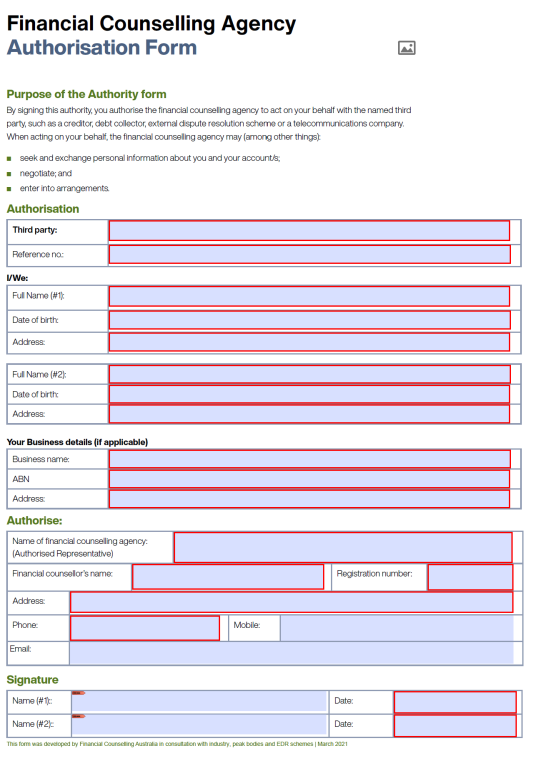
Purpose of the Authority form
By signing this authority, you authorise the financial counselling agency to act on your behalf with the named third party, such as a creditor, debt collector, external dispute resolution scheme or a telecommunications company. When acting on your behalf, the financial counselling agency may (among other things):
- seek and exchange personal information about you and your account/s;
- negotiate; and
- enter into arrangements.
Guide – Financial Counselling Agency Authorisation
Purpose of the authority
The purpose of this form is to have an agreed acceptable authority a financial counsellor can send to a third party. A third party could be a creditor, debt collector, external dispute resolution scheme or a telecommunications company. The authority covers all accounts that a person has with that third party.
It is important that your client is aware of how the authority will work.
The ACCC/ASIC Debt Collection Guideline at Section 9 provides information regarding the expectation of creditors and debt collectors that they will accept this authority.
Using the authority
A client may give a financial counselling agency the authority to act on their behalf with a third party. This means that the third party will deal with the agency.
The financial counselling agency and its representatives must do the following:
1. Include the financial counsellor's national registration number on all correspondence with the third party including the authorisation form (this enables the third party to verify your identity);
2. Notify the third party in writing if the financial counselling agency stops assisting the client (notification is not necessary if the matter has settled); and
3. Notify the third party if the financial counsellor acting on behalf of the client changes.
Separate authorities
A separate authority is required for each third party. You only need one authority for each entity (for example, if a bank has divisions the authority covers the bank and those divisions). A separate form is also required to make a complaint to an external dispute resolution scheme. This is to ensure that:
- Each third party gets a clearly addressed authority; and
- There is no confusion about how many third parties there may be; and
- To avoid explaining the possible privacy implications of sharing this information.
Explaining the authority
You must explain to your client why they are signing the authority form. This information will cover the following:
- The authority is required to access the personal information of the client that is held by the third party. The Privacy Act requires that the third party has the client's consent to access any of the client's personal information.
- The authority also means you can act on behalf of the client to deal with the third party. This means that the third party will deal with the financial counsellor as if it were dealing with the client.
- That you have professional and ethical obligations as a financial counsellor and these include that you will at all times keep the client informed of developments.
- That you will seek instructions from the client when major decisions are required. By then acting on those instructions you are then able to make arrangements or settlements with the third party that are binding (on behalf of your client).
- Explaining that it is important that the information provided to the third party must be true and correct.
- Explain that the third party may still send routine correspondence to the client or correspondence as required by law (for example, account statements). Correspondence relating to the dispute or inquiry must be sent to the financial counselling agency.
- The client can revoke the authority at any time and you will inform the third party accordingly.
- When you close the client's case, you will also revoke the authority with the third party.
Account numbers
Providing at least one account number or a reference number on the form will assist the third party in identifying the client's accounts. If an account number is not available leave this section blank but explain why in any cover letter or email.
Additionally, the account number, product type and account holders should be included in any cover letter or email.
Client details
You should provide as much information as you can to help the third party identify your client. This information may include your client's full name, date of birth and address, plus the address where the service was provided where relevant.
There may be circumstances where a client cannot provide their address. This could be because, for example, the client is homeless or is escaping family violence. If this situation applies then you should leave this section blank and explain why or provide further information in the cover letter that the third party can use to identify the client.
Revoking the authority
An authority can be revoked at any time and for any reason. Common situations when an authority is revoked are:
- The financial counselling agency ceases to act on behalf of the client,
- The client has not responded within a reasonable period of time, or
- The client puts in place another authority.
You need to revoke the authority in writing when you cease to act for the client. If the matter is settled then there is no need to revoke the authority if it is clear between the parties that the matter has concluded.
Can the third party creditor contact your client directly?
A third party can contact your client directly if:
- Your client requests that the third party contact them;
- You do not respond to communications from the third party within a reasonable time (7 days) and the third party has warned you that they will contact your client if you do not respond in a reasonable time (7 days); and
- The third party asked for written authority and you do not provide that written authority in a reasonable time.
Note: If the third party contacts the client directly it does not revoke this authority.
Disclaimer: The Australian Finance Industry Association Limited ABN 13 000 493 907 (AFIA) gives no representation, makes no warranty, nor takes any responsibility as to the accuracy or completeness of any information contained herein and will not be liable in contract, tort, for negligence or any loss or damage arising from reliance on any such information.
Footnotes
1. In line with ASIC’s Indigenous Financial Services Framework, the term ‘First Nations peoples’ is used in preference to the terms ‘Indigenous Australians’, ‘Aboriginal and Torres Strait Islander peoples’ and ‘Indigenous peoples’. This term refers to the diverse First Nations peoples and their communities across Australia.